
The Road Not Taken: the Broken Math of the BQE.
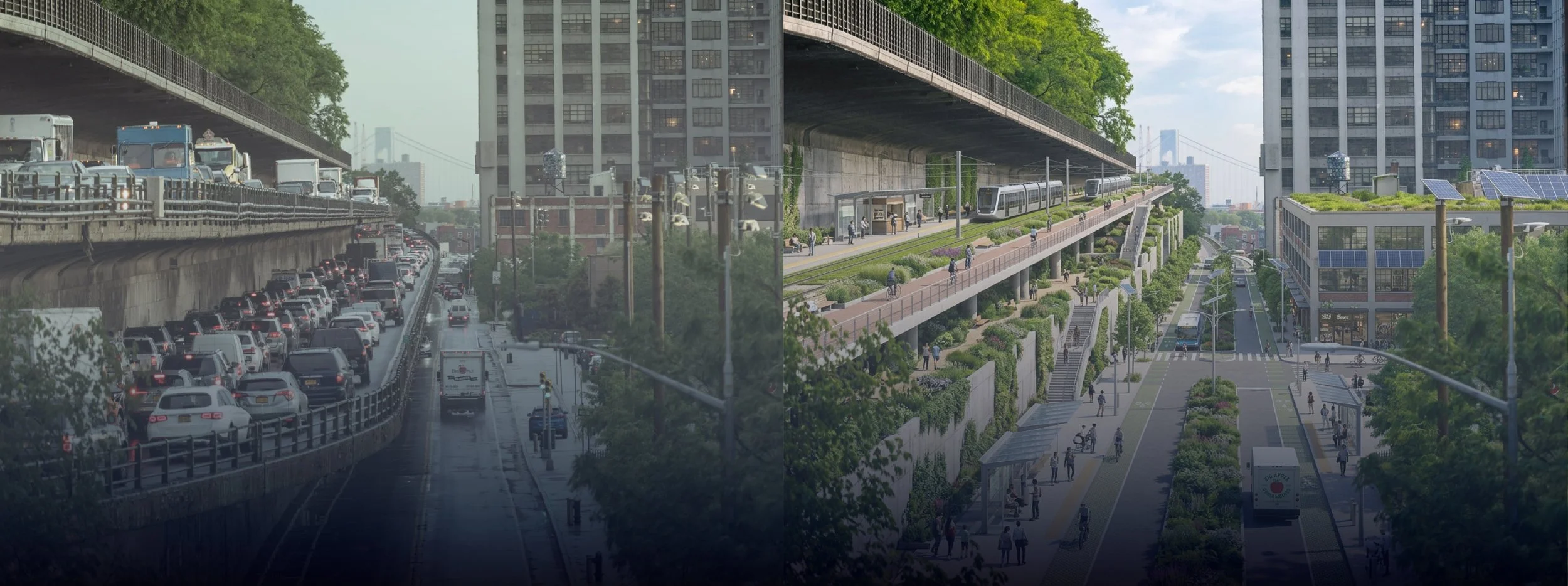
The BQE’s triple cantilever today, and how we might replace it
By Cindy McLaughlin, Founding Member at Off-Ramp
The assumption in New York today is that the Brooklyn Queens Expressway (BQE) is crumbling and therefore must be rebuilt — that we should spend tens of billions reconstructing mid-20th-century infrastructure designed by Robert Moses for a city in a spasm of “urban renewal”. And that in doing so, we will simply consign ourselves to another century of the same congestion, pollution, noise, severed neighborhoods, traffic violence, and economic dead zones that this highway has produced since it tore through Brooklyn and Queens.
Off-Ramp NYC built a financial model to ask a different question: What if we stop rebuilding our highways and start rebuilding our city?
Off-Ramp NYC built a financial model to ask a different question: What if we stop rebuilding our highways and start rebuilding our city?
To our delight, we found that removing the BQE from the Verrazzano to the Kosciuszko Bridge, demolishing the corroded elevated sections, filling in the trenches, and replacing it all with light rail, at grade, would save the city over $20b over 30 years, and create an annuity of tax and farebox revenue. It would also leave us with a more beautiful, less polluted, more affordable, more human-scale NYC.
Highway removal is not a new idea. It has been done in cities around the world including New York itself, on the West Side Highway. Every city that has removed a highway has seen revenues rise, costs fall, neighborhoods heal, and economic activity flourish. None has asked for its highway back.
The argument in favor of keeping the BQE goes something like this. “But it’s a critical freight corridor!” This is true, today. But only 8% of traffic on the BQE is trucks. Investing in a grand highway that encourages ever-larger big rigs to drive directly through NYC neighborhoods is poor citybuilding. Considered more holistically, demand management (package pricing, overnight delivery hours, truck size regulation and enforcement) and major investments in alternative modes (e-cargo bikes, e-vans, barges, excess capacity on overnight public transit) can and should be used to shape demand and enable more sustainable, human-scale delivery.
Our model compares two futures for the BQE. In one, we rebuild it over years, widening it to meet federal highway standards, and building new “temporary” bypass highways alongside to maintain the flow of traffic during years of construction. In the other, we replace the entire corridor with tree-lined boulevards, at-grade light rail, parks, and miles of new housing; reconnecting neighborhoods and street grids that have been severed for generations. The model attempts to quantify what each future would cost, and what each future would create.
The results are meant to start a conversation, not end one. Honest analysis requires acknowledging the uncertainty and disruption and ripple effects that comes with projects of this scale. But even the most conservative estimates point in the same direction: removal saves the public more money every year and adds active and public transit, while eliminating a major source of pollution, blight, household cost, and danger.
The Reconstruction Bill Is Not Just the Cantilever
NYCDOT's 2022 cost estimate for rebuilding the triple cantilever and BQE Central was $5.5 billion. That estimate predates a 50% tariff on steel, aluminum, and copper; and construction inflation, estimated by analysts to be 40 to 55 percent from 2022 through 2025. A reasonable 2026 estimate for that same 1.5-mile section is close to $8 billion before scope changes, overruns, or the additional years of inflation between now and groundbreaking.
Extended to the full 11.7-mile BQE corridor, which will eventually require similar rehabilitation, with different budgets for different highway topologies, our modeling puts comprehensive 30-year reconstruction debt service at $35-40 billion, plus another ~$2 billion of operations and maintenance.
What does that investment buy? Decades of noisy, polluting construction as we erect bypass highways through the heart of NYC, then tear down the aging highway sections, and build new ones before tearing down the bypasses. Then another century of a now-wider roadway (built with 12’ lanes and 10’ shoulders to federal standards) that still runs 40-ton trucks through dense residential neighborhoods, and still generates the traffic violence and associated grief, and air and noise pollution, and parking demand that urban expressways reliably produce. We would be purchasing another lifetime of some of our city’s worst problems at extraordinary public expense.
What Removal Actually Costs
Removing the BQE—demolishing or repurposing elevated sections, filling in the trenched segments, and converting the right-of-way to a surface boulevard with 35 track-miles of light rail—is not without cost. It, too, would entail years of significant construction. Our modeling puts 30-year debt service for a project like this at roughly $10-15 billion, about a third of the reconstruction price, plus $4 billion of transit operations and maintenance. Farebox revenue and catalyzed real estate value bring the net 30-year cost to approximately $12.5 billion.
The Land Beneath the Road
A removed BQE right-of-way contains approximately 75 acres of developable land. In one of the most space- and housing-constrained cities in the world, this is an extraordinary public asset sitting dormant beneath a deteriorating structure.
Our model was developed assuming that 80% of this newfound land would be devoted to “public benefit”, a mix of social housing, parks, community centers, etc., with the remaining 20% sold and developed at market rate. The market-rate land could generate significant new income, producing a one-time land sale of roughly $750 million, partially offsetting removal costs. Even assuming the land is 100% “public benefit,” removal still would cost far less than rebuild.
The Annual Ledger
Every year the BQE stands, taxpayers spend an average of $45 million on routine maintenance and >$100m more on escalating structural intervention across its deteriorating cantilevers. A rebuilt highway would likely cost closer to $15 million/year annually after rehabilitation, but would still be a pure cost center.
Removing the highway and replacing it with light rail (or bus rapid transit) changes the ledger. In this scenario, the public would likely break even—plus- or minus $0.5b-–as farebox revenue and new property tax from the reclaimed acreage roughly net out transit operating and maintenance costs.
This future demonstrates the difference between infrastructure that consumes public resources and infrastructure that replenishes them.
The Household Bonus
Only 42 percent of New York City households owns a vehicle. Those that do own an average of 1.4 — at a blended annual cost ranging from $18,000 with free on-street parking to nearly $60,000 with paid off-street garage storage. A household drawing instead on transit, Citi Bike, ferry connections, and rideshare might spend between $7,000 and $19,000 per year. Under Fair Fares, and primarily using OMNY, considerably less.
None of these figures incorporate health savings from reduced pollution, fewer crashes, productivity gains from reduced congestion, or the stress reduction and quality-of-life improvements that follow when a city becomes greener, quieter, safer, and genuinely livable. These benefits accrue to drivers too.
For some in NYC, car ownership is simply a convenience. But for far too many, it’s a necessity. The fastest way to change the household math for those who are burdened by cost is to replace the space we currently devote to highways with a robust public transit system “arterial” that connects adjacent NYC neighborhoods. A truly affordable city is one where nobody needs to own a car.
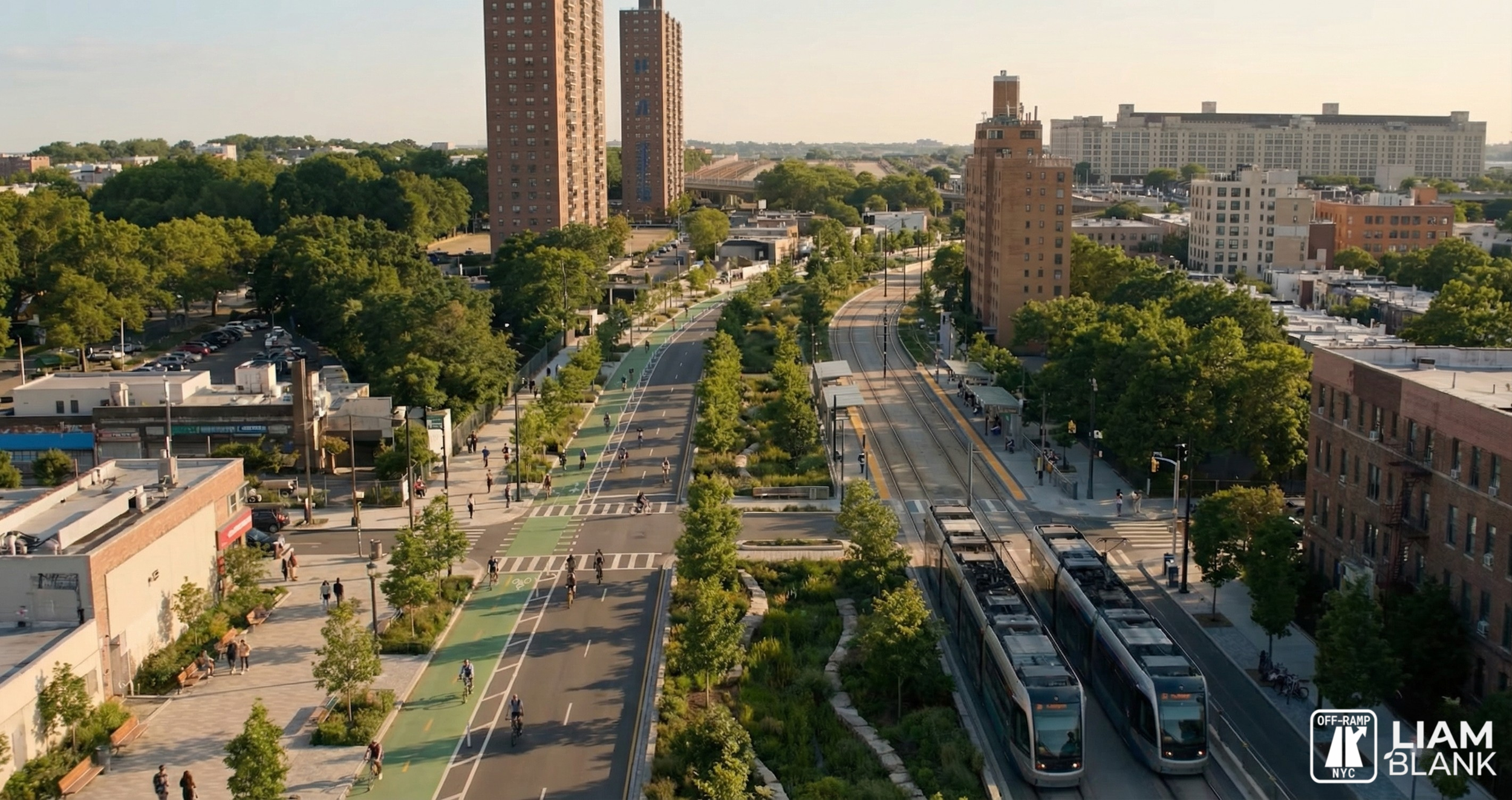
Image by Liam Blank for Off-Ramp NYC
The Fiscal Objection, Answered
Proponents of reconstruction often frame it as the fiscally conservative position — prudent, incremental, responsible. The arithmetic argues otherwise.
NYCDOT's FY2025–2028 capital plan allocates >$160 million/year for the BQE — enough for interim repairs, not a structural solution. Federal reconstruction grants have been sought and denied. Full reconstruction would not be fiscal conservatism. It would be a fiscal catastrophe dressed in the language of necessity.
Removal, by contrast, is partially self-financing through land value capture — even at a conservative 20 percent market-rate allocation. More market-rate land means more cash flow. Capital costs are lower. The timeline is shorter. The revenue is real, recurring, and durable. And unlike reconstruction, the economics – and the city – improve over time.
The BQE debate is often cast as a question of political will. That framing isn't wrong, but it's incomplete. This is equally a question of arithmetic. And on that question, the answer is unambiguous.
Rebuilding costs more, generates no revenue, and locks the city into a century of infrastructure that has long outlived its era. Removal costs less, generates billions in public value, and converts some of the most underutilized and valuable land in Brooklyn and Queens into a productive, equitable asset for the next generation of New Yorkers. What are we waiting for?
